Showing posts with label theology. Show all posts

Monday, January 19, 2015

On Lovecraft and My Catholic Worldview

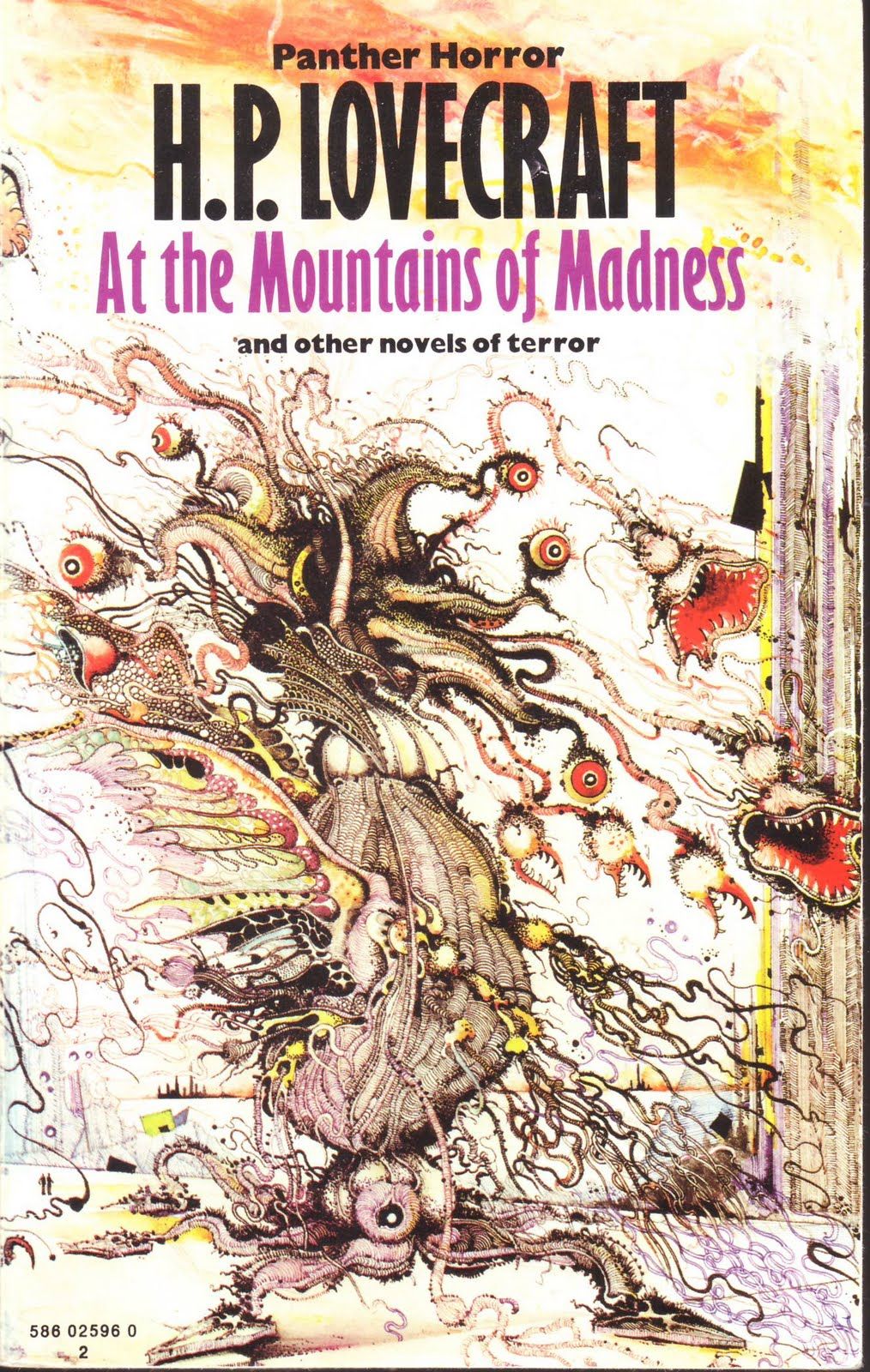
A few months ago, I bit the bullet and read my first H.P. Lovecraft story, the novella At the Mountains of Madness. I'd been hearing about Lovecraft for years, and knew he was well-respected by later authors and quite beloved by many, so I figured it was about time.

Bonus points to whoever correctly identifies
the number of eyes on this book cover.
Boy was I wrong!

It was a new-to-me kind of frustrating, because I could tell that I was supposed to be terrified (or at least anxious or creeped out), yet the only emotion I could muster was impatience.

I asked around, to try and understand what I was missing, but all replies suggested that while Lovecraft's mythos is phenomenal, he could have done with an editor. Ok, fine. Forgot about it for a while.

Those eldritch wall paintings are more interesting than wallpaper, at least.

But last week I stumbled upon a virtual book club reading this very book, so I thought I'd ask them if they could convince me of Lovecraft's genius, and their responses were thorough and helpful.

I should consider Lovecraft in his own time, they said, based on the way scientific researched changed their understanding of reality. Okay:
The TL;DR version is that when Lovecraft was born the sun was thought to be, at absolute most, around 20 million years old. When he was an adult we had discovered that the sun was powered by fusion and was around 4.5 BILLION years old. As a child Lovecraft thought the universe consisted of the milky way, around a million stars total, and a few blurry things no one knew what were. As an adult it was known that a) the milky way contained closer to 100 BILLION stars and b) all those weird blurry things were in fact galaxies as large as the milky way.
The cosmos expanded during Lovecraft's life at a rate comparable to the rate of expansion of available data storage during my life. I was born in late 1964. In 1973, the total manufactured fixed disk storage capacity in the United States was on the order of 100Gb. 40 years later, it's really hard to buy hard disks that small; hard disk storage currently costs on the order of 4 cents per gigabyte, giving our 1973 USA's installed hard disk capacity a value of around $5.
Ok, that IS a pretty huge series of changes. But what makes this terrifying? I needed someone to point it out to me. [Spoilers ahead, but plot isn't necessarily the point with Lovecraft, so whatever.]
Now think back to At the Mountains of Madness. The horror is not that the Elder Things, these half-plants / half-animals that have been hibernating for millions of years might come to once again re-inhabit the Earth, it's that even this wondrous creatures, to whom we are nothing more than ants, were themselves wiped out by something even bigger, more awesome, and more terrifying than they were.
Okay! That I can wrap my head around! But I still can't get my emotions there. I can appreciate his creations from an artistic standpoint, but they still don't creep me out.

Although they are still unsettling to look at.

This disconnect between brain and emotions simmered on the back burner of my mind for a few days, until finally, after returning from a wonderful retreat, it hit me:

What completely undercuts the eldritch horror of Lovecraft's world and creatures is Catholic theology!

Sorry not sorry. Couldn't resist!

Now, I've read explicitly atheistic authors before, but none were trying to terrify, so it's hard to compare. And no wonder Lovecraft's creatures do inspire so much fear; the world they represent is precisely the opposite of that in which our all-loving God has not only created but redeemed us!

Think about it. At the heart of Christian theology is that God, who needs nothing, created us just because he wanted to love us. Then he actually took on human weakness and died violently, painfully, so as to redeem not only all humanity, but each human being! His love for each one of us is profound especially in light of the enormity of the cosmos!

This image is not to scale.

It's all so enormous and grand! And we are so small, so short-lived. And yet, what dignity we are afforded, by virtue of the incarnation!

All this, just for a chance to spend eternity with you!

Angels, the only non-human sentient species mentioned in Scripture and Tradition, are metaphysically superior to us, being pure spirit--and we are explicitly praised as higher than the angels! How could any species, no matter how powerful, compete with love like that!?

You may be gigantic, powerful, ugly, and brutal, but you cannot deprive me
of the life that really matters, so why should I fear you? (cf. Mt 10:28)

Deus Pater, qui creavit omnium, miserere nobis.

Monday, February 11, 2013

On the Papal Resignation: Words of Comfort

...because what the world needs is another blogger posting her two cents. Still, here I am.


After the initial shock of this news resided, I looked back over papal/curial decisions in recent months and could see that some of these may well have been Papa Benny preparing for his own departure (for I am certain this decision was long-discerned).

And then I felt ashamed of my lack of virtue. My fear betrayed that my great love for and trust in the holy father laid not in the Vicar of Christ nor in the Holy Spirit but in Joseph Ratzinger. Surely this great man has been an inspiration to me personally, and has had great impact on my life, but ought I not to have more faith in the Holy Spirit Himself!? At the very least, should my unshakable faith in our dear Papa not extend to trusting his decisions?

I readily admit that the sorrow at the loss of such a wonderful pope has not sunk in yet at all. But it is natural to look to the future, and in this vein, I offer a few thoughts of comfort.

-The Church has had a possibly unprecedented string of holy (arguably saintly) popes in the past hundred years or so. This seems to be something that most Catholics value (save those who take it for granted).

-That doctrine your friends/family/co-workers are hoping will be changed with the next pope? No danger of that happening.

-You know that cardinal whose name people keep mentioning, but you think he'd be a terrible pope because of XYZ? You can be sure that other cardinals, who are paying much more attention to each other than you are, have noticed said character flaw (or whatever) in his person, even if your Catholic friends or well-known journalists don't. I wouldn't be too concerned.

And even if the next pope is a man whose election concerns you, perhaps you can take some comfort in this legend I heard in a lecture in grad school:

Back in the heyday of the Arian controversy, there was an influential queen who reeeeeally wanted Church teaching changed to the Arian position (because obviously her opinion was the correct one). So she schemed and whatnot, and sure enough, when the pope died, and her right-hand man, a prominent Arian bishop, was elected to be his successor.

...at which time this devoted Arian pulled a complete 180 and supported the true doctrine of Jesus' divinity.


Pope St Celestine V, pray for us, for Pope Benedict, and for the man who will be our next pope.
Holy Spirit, increase my trust in you.

Friday, November 16, 2012

7 Quick Takes, Vol. 11


~1~
My talk on the Year of Faith was last night, and by all accounts, it was a great success. Even the handful of traddy friends who came, who can't possibly think Vatican II was all that great, spoke very highly of it even when I asked specifically for their criticisms!

~2~
Every time I give a catechetical talk, I come away from it thinking, I really need to give more talks. This, combined my recent experiences at a weekly Bible Study, may be encouraging me to rethink the way I involve myself in ministry and the kinds of positions I may look at.

Or I may just go out of my way to be in a position to give more talks. That's fun, too. :)

~3~
Speaking of last night's talk (the slides for which I will share here sometime, probly next week), I bring you my single favorite slide from the whole presentation:


I'm actually kind of surprised that it worked out so well. And rather pleased with it. :D

~4~
Speaking of Vatican II, this presentation made me realize that I haven't actually read all its documents (for shame!). I mean, I've read Sacrosanctum Concilium about three thousand times, give or take, and I've at least heavily skimmed the other 3 constitutions, but I'm not sure I've done more than spot check paragraphs in the declarations or decrees.

I guess I have a new resolution for the Year of Faith...

~5~
I love the internet. I really do. In addition to somebody scanning nearly all the images from the Baltimore Catechism (don't read the comments; they're snarkier than usual), I found some real gems while assembling this presentation. Some examples:

This was found while seeking a caption for a line from the pope's
Wednesday Audience this week: "Christianity, before being
a moral or ethical system, is the advent of love,
it is to welcome the person of Jesus.
" (emphasis mine)

For explaining the theological concept that time is a creature: a time creature.

Okay, those were my favorites. Hopefully I haven't now spoiled your entire reason for wanting to look through my coming slideshow. :)

~6~
So, earlier this week I made myself Kraft mac and cheese (don't judge my comfort food), and poured for myself the last of a bottle of wine, left over from a movie night earlier in the week. There was a bit more wine than I was expecting, so I looked in the bubbling pot of cheese sauce, thought to myself, actual cheese sauces often use wine, so what the heck? and poured some in. Surprisingly positive result. I would recommend it. Ya' know, the next time you're having a wine-and-comfort-food kind of dinner. :)

~7~
Simcha shared this video today, and I'll be honest, I kind of love it. Not to beat a dead horse, but the internet is truly a marvelous place.


And that's a wrap! Jen's got the rest. (And you really should head over, if only to look at the picture she's got listed as #3. Brilliant! I love Catholics.)

Thursday, November 8, 2012

Book Review (sort of): Rome Sweet Home

So a bunch of friends wanted to start a book club, and the book that was chosen to launch the thing was Scott and Kimberly Hahn's Rome Sweet Home. It meets tomorrow, but since there will be close to a dozen of us there, they probably don't want to hear all my thoughts on it... Fortunately, that's why God made the internet (right??).

Book cover as it appears on Amazon...
I have three discrete reactions to the book, aside from feeling generally favorable toward it and them, and agreeing that it was a quick and pleasant read.

Growing to appreciate the Hahns as people

See, having gone to Steubenville, I noticed that most people fell into one of two categories regarding Dr Hahn (with rare exceptions): Either you were familiar with his work before college and loved him, or you regarded him as overrated and were annoyed when every third person who learned where you went to school asked with awe, "Did you ever have class with Scott Hahn!?"

(Unspoken response: No, because for every one Scripture class Dr Hahn teacheswhich is always a night classDr Bergsma teaches 7, which are at least as good. Besides, Hahn just assigns you to read his books as your homework, and it's harder to get a good grade in his class, yet it doesn't seem like his students learn anything more than or different from Bergsma's students...)

Anyway, this book humanized the Hahns and gave me something in common with them, something I never realized was sorely needed. Now, drawn in by seeing the way theology has driven their lives, I am actually inclined to take advantage of Dr Hahn's apparent theological genius and check out some of his other books (this new one looks pretty awesome)...

A surprising observation that probably shouldn't be a surprise

[SPOILER ALERT!]
As the book progressed, I found myself identifying much more with Scott than with Kimberly. I account two factors for this:

1) I have not yet experienced anything that made me deeply fear seeking the truth (I've put it off for a month or three, maybe, but even then, not since high school). Kimberly's stubbornness of heart was rooted in a particular fear connected to a part of her life that she refused to give to God for a long time. This is not something that my experience connects me with. (Deo gratias!)

2) Kimberly's day-to-day life was drastically changed by having children to care for. As I am still single, I have nothing more practical, more important (except perhaps working enough to pay my bills, which is hardly the same) to distract my mind from the work of theology.
[/SPOILERS]

Not that I think most people reading a conversion story are concerned about spoilers, but hey! they happen.

A new conviction

I'm not usually the person who comes away from a talk, homily, book, discussion, etc., saying, "That really hit home; I need to do more (or less) of X." Yet this book convicted me: I need to read more theology.

There's an excitement, a romance to studying the things of God! Reading about Scott's journey really made that present again. It was easy to forget that when the reading was assigned, and sadly, extracurricular research is easy to neglect, despite its joy.

With caution not to overload my resolutions for the Year of Faith, I do intend to read more theology. At least weekly is feasible, right?

Cover of the book I actually own, which saved
me $4 and gave me this great 80s photo to boot!
Anyway, the book was fun, and an easy read. Having gone to college with two of their three oldest kids (still very young children by the end of the book), it was kind of fun to take this look back in time. I do recommend it. Two thumbs up!


Let us pray also for all our brothers and sisters who believe in Christ,
that our God and Lord may be pleased,
as they live the truth,
to gather them together and keep them in his one Church.
Let us pray.
Almighty ever-living God,
who gather what is scattered
and keep together what you have gathered,
look kindly on the flock of your Son,
that those whom one Baptism has consecrated
may be joined together by integrity of faith
and united in the bond of charity.
Through Christ our Lord.
Amen.
Good Friday Liturgy of the Passion of the Lord
Solemn Intercessions, V.: For the Unity of Christians

Sunday, October 28, 2012

Consecration of the Human Race to the Most Sacred Heart of Jesus


Most sweet Jesus, Redeemer of the human race, look down upon us humbly prostrate before Thine altar. We are Thine, and Thine we wish to be; but, to be more surely united with Thee, behold each one of us freely consecrates himself today to Thy most Sacred Heart. 


Many indeed have never known Thee; many too, despising Thy precepts, have rejected Thee. Have mercy on them all, most merciful Jesus, and draw them to Thy sacred Heart. Be Thou King, O Lord, not only of the faithful who have never forsaken Thee, but also of the prodigal children who have abandoned Thee; grant that they may quickly return to Thy Father's house lest they die of wretchedness and hunger. 

Be Thou King of those who are deceived by erroneous opinions, or whom discord keeps aloof, and call them back to the harbor of truth and unity of faith, so that there may be but one flock and one Shepherd. 

Be Thou King of all those who are still involved in the darkness of idolatry or of Islamism, and refuse not to draw them into the light and kingdom of God. Turn Thine eyes of mercy towards the children of the race, once Thy chosen people: of old they called down upon themselves the Blood of the Savior; may it now descend upon them a laver of redemption and of life. 

Grant, O Lord, to Thy Church assurance of freedom and immunity from harm; give peace and order to all nations, and make the earth resound from pole to pole with one cry: "Praise be to the divine Heart that wrought our salvation; to it be glory and honor for ever." Amen.

Wednesday, October 10, 2012

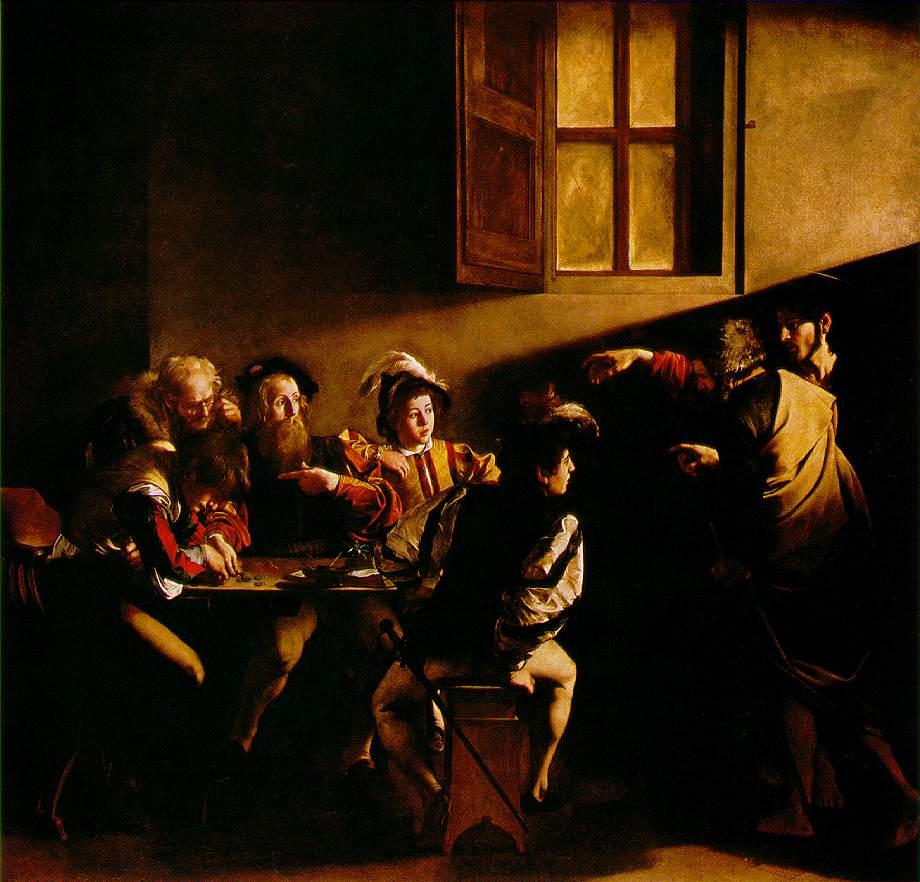
Modern-Day Tax Collectors ?

It occurs to me that, in order to put into perspective what people meant when they scorned Jesus eating with tax collectors and sinners, we might want to consider the modern-day equivalents: lawyers (and/or maybe politicians).

No offense intended to lawyers and politicians; there are some genuinely good people in the batch, at least a few of whom I would positively enjoy spending time with. But consider the stereotype, the reputation: corrupt quasi-government officials, taking advantage of their positions of influence to fleece innocent people out of their money...

Think about it. Wouldn't it seem at least a bit weird for Jesus to go eat dinner with a bunch of lawyers, when so much of his ministry was to the poorer classes, and so much of his remaining time spent with priests and religious leaders?


St Matthew the Apostle, pray for us.
St. Thomas More, pray for us.

Tuesday, September 11, 2012

"So what's your favorite part of the new translation?"

I've been traveling in liturgical circles for a little while now. So while this new translation of the Missal didn't take effect until this past Advent, I've been familiar with quite a number of the texts since the fall of 2007.

Yet it still caught me completely off guard when I was catching up with a dear friend, then finishing her notiviate with the Carmelites, and she asked me what my favorite part was of the new translation. Well, I don't know. The whole thing, really. I'm a huge fan of this whole formal equivalence principle of translation, wherein the English kind of sounds like the Latin does, only, ya' know, in English. She, in response, had some incredibly profound reflection on how one particular phrase was a real testament to God's incredible love for us (unexpected profundity has always been one of her strong suits, but still).

I don't generally have "favorites" very often, of anything, yet her question stuck with me. And now, that I've been praying this translation day in and day out for months, I do have a favorite part: "poured out," during the consecration of the chalice.

take this, all of you, and drink from it,
for this is the chalice of my blood,
the Blood of the new and eternal covenant,
which will be poured out for you and for many
for the forgiveness of sins.
do this in memory of me.

We used to pray "which will be shed." Most (possibly all) of the English hand Missals printed in the 19th and early 20th centuries, used by parishioners to pray in English what Father prayed in Latin, translate that as "shed." Even hand Missals being produced now for the traditional Mass seem to all say "shed."

Part of the rationale given for the change was that "shed" is inferior because it only works for blood, not for wine (you can't really shed wine), so "poured out" is better because it's more symbolic and evocative and whatnot. That's all well and good, and entirely true, but still falls short of the fullness of the Latin original.

The Latin original of the word in question is effundetur. I'm no great Latinist, but they tell me effundetur means more than "shed," more even than "poured out." It means emptied out of every last drop. Think of when Our Lord was scourged, then crowned with thorns, then crucified, and even then, after He had died, the soldier pierced his heart with his lance, and more blood (and water) flowed out. He gave and gave and gave until he quite literally had nothing left to give, no blood that had not been spilled for our sake.


THAT is how we are called to love in His image: to give of ourselves, for the love of Him and of His children whom He has entrusted to us. We are to give and give and give -- and even when we're completely at the end of our rope and couldn't possibly give any more, to give just a little bit more. He'll be right there, giving us the strength to do it, just as He did on that Good Friday so many years ago.

You'll never read this, Sr Teresa Margaret, but I can now tell you: my favorite part of this beautiful new translation of the Roman Missal is that reminder of the fullness of His sacrifice -- literally to the last drop. Thank you for putting that question in the back of my mind all those months ago, and for your prayers which probably led me straight to this reflection. I only pray that each day I may pour myself out for Him half as lovingly as He did for me.

Sanguis Christi, in Cruce effusus, salva nos.

Cor Jesu, lancea perforatum, miserere nobis.

Friday, August 19, 2011

On Jephthah, Listening, and Right Worship

Yesterday's first reading is one that I always find profoundly disturbing. I know that the Old Testament authors don't moralize, but merely present stories and consequences, forcing us to draw conclusions. It's been explained to me time and again that Jephthah made a stupid promise rather than asking God what He wanted. Yet this reading unsettles me every single time.


But Father glanced past a fascinating point yesterday, upon which I have dwelt ever since. Human sacrifice was not just a pagan practice - it was a pagan cultic practice. It wasn't just a thing Gentiles did; it was an integral part of how they worshipped their gods.

We see over and over throughout the Old Testamenthow  the people of God strayed from His commands and worshiped other gods. This is not just a tragic story of a great man making a stupid vow, and consequently sacrificing his only daughter. This is yet another story of the importance of worshipping God the way He has asked us to worship Him.

One can be successful, even winning great victories for God's people, and still worship Him in a horrifyingly wrong way. That makes the victories no less triumphant, the man no less well-intentioned. But how much less tragic our lives might be if we just followed the liturgical customs God has given us!

Dominum Deum tuum timebis, et ipsi servies ac per nomen illius iurabis.

Wednesday, November 3, 2010

On Humility in Intercession

We all pray for our loved ones.  It's the most natural response to worry, especially when we're powerless to effect change in their situation that gives us pause.  Too, our first response to a frustrating situation is to ask for the obvious solution:

Dear Lord, please don't let Pat get laid off.
Please heal Sarah from her illness soon.
Please let Phil get into the grad program he so desperately wants to attend.
Please stop Julie's boss from blaming her unreasonably for the department's problems.

But this is not always the most efficacious prayer.  The Lord's ways are much more mysterious than ours; maybe Pat won't meet the person who connects him with his dream job unless he loses his current one.  Maybe Sarah's death will be the catalyst that draws her entire family back to God.  Maybe Phil needs to learn that failure is not the end of the world, and will get a better education at his backup school.  Maybe the extreme humility Julie is forced to learn in the face of injustice will come to play an invaluable role in making her a better mother to the children she will have five years down the road.

It's hard to see those we love suffer.  I gain much consolation these days from meditating on the Sorrowful Mysteries and the Stations of the Cross.  Our Lady was there, following along every step of the way.  She watched her son be wrongly accused, brutally beaten, humiliated in every possible way, and slowly - violently - murdered by the state.

I return frequently to the Fourth Station: Jesus Meets His Mother.  The two of them make eye contact as He's struggling along the road to Calvary.  What did her eyes say to Him?  The most noble and fitting explanation I've ever heard is that her eyes communicated love and encouragement: "You can do it!"  Certainly she shared His pain, and assuredly He knew that.  But to accept that you have to watch someone you love in pain and suffering, even when you know it's for the greater good, is one of the harder crosses to bear.

So lately, I've changed my prayers.  For those who are close to Our Lord, who might listen to Him in the face of crisis, I put aside my own desire for their immediate happiness.  I don't ask for an end to their oppression, just or unjust.  I don't ask for them to receive that which they feel (as do I) is owed to them.  Rather, I swallow my fears and ask for their sanctification in this particular situation.  May Joey's struggles in this class draw him nearer to You. May Harry and Denise's great desire for children in the face of infertility make them holier.  May Terri withstand the awful treatment her mother-in-law is giving her, and may it lead to both their sanctification.

It's a hard prayer, but one that Our Lady keeps reminding me is important.  This life is full of sorrows and suffering, and there really is no easy way out.  The purpose of this life is to draw close to God and to draw others close to Him.

Mater dolorosa, ora pro nobis.
Mater cruci corde affixa, ora pro nobis.

Friday, August 20, 2010

On "Maximum Personality"

Human nature was made with the capacity to participate freely and willingly in a process of growing into the likeness of God. Created in the image of God, a human person also lives by relationship, and this provides for maximum individuality. God planned beings who could attain maximum personality.
-David Fagerberg, Theologia Prima, p24

Maximum personality. What a phrase! And situated so, as a gift one attains through relationship. As the persons of the Holy Trinity are eternally in relationship with each other, so are each of us called to relationship with those around us, to love those around us as the Trinity loves.  It is through these relationships - as well as through our relationship with God, of course - that we are principally to achieve holiness.

We know this from many theologians. But look at Fagerberg's last phrase there: to attain maximum personality. Through relationship, we achieve holiness; through relationship, we achieve maximum personality. The holier we become, the more we become truly ourselves? the more our own unique personality shines out?

Perhaps this is why so many saints and holy people are and have been such eccentric folks with habits strange and delightful.  Now that's a model of life I could strive for!

O Jesus, meek and humble of Heart, make my heart like unto Thine.

Saturday, April 3, 2010

The Good Friday Reproaches

I'd never before paid attention to the Reproaches that are sung on Good Friday, during the Veneration of the Cross.  Such a beautiful juxtaposition of God's goodness to our sinfulness!  Consider them the words of Christ on the cross to his chosen people.

My people, what have I done to you? or in what have I offended you? Answer me.

Because I led you out of the land of Egypt: you have prepared a cross for your Savior.

Holy God. Holy, mighty One. Holy, immortal One, have mercy on us. (2x, in alternating Greek and Latin)

Because I led you out through the desert in forty years, and fed you with manna, and brought you into a very good land: you have prepared a cross for your Savior.  Holy God...

What more should I have done, and did it not? Behold, I have planted you as my fairest vine, and you have become very bitter to me, for you have quenched my thirst with vinegar, and with a lance you have pierced your Savior's side. Holy God...

For you did I scourge Egypt and its firstborn, and you have given me over to be scourged. My people...

I led you out of Egypt, overwhelming Pharaoh in the Red Sea, and you have delivered me to the chief priests. My people...

I opened the sea before you, and you have opened my side with a lance. My people...

I went before you in a pillar of cloud, and you have haled me to the judgment hall of Pilate. My people...

I fed you with manna through the desert, and you have smitten me with buffets and with lashes. My people...

I gave you the water of salvation to drink from the rock, and you have given me gall and vinegar to drink. My people...

For you I smote the kings of the Canaanites, and you have smitten my head with a reed. My people...

I gave you a royal scepter, and you have given my head a crown of thorns. My people...

With great power I lifted you up, and you have hung me upon the gibbet of the cross. My people...
(Translation adapted from the Institute of Christ the King)

Thursday, April 1, 2010

On Two Sinners

Tonight Anne and I went to a local Byzantine parish for Liturgy.  Much was beautiful, but what struck me most were some of the proper prayers for the day, based on the gospel.

The gospel reading covered both the woman who poured her costly oil on Jesus' feet and Judas' agreement to betray Jesus for 30 pieces of silver.  Those prayers beforehand drew out the connection between the two, highlighting the simplicity of her costly gift (amid her sinful life) in contrast to his greedy treachery (hidden by his facade of virtue).  I wish I could reproduce the prayers for you here, because I simply cannot imitate the brilliance of the East with which they shone.

Instead I assure you of my prayers for you, and exhort you to keep in mind the model of the sinful woman.

Remittentur ei peccata multa quoniam dilexit multum.

Monday, November 23, 2009

On Symbolism, or the Church as She

Does it scandalize you to learn that the Fathers called the Eucharist a symbol?

If you understand symbolism the way contemporary man does, then that should upset you.  In response, you might consider looking to a more ancient theological understanding of symbolism.  A symbol, then, is not a mere sign pointing to what it signifies; rather, it reveals what it signifies in such a way that it actually contains it without limiting the thing signified to the revelation in the symbol.

That is to say: A stop sign is not a symbol, nor are those arrows that label this button the one that fast forwards.  Consider instead the human body.  Human beings are ensouled bodies; our souls cannot  communicate with each other without the use of our bodies (whether that's to act or even just to speak or write).  In this way, our bodies symbolize our souls, without reducing our souls to only that which is communicable via the body.

This view of symbolism is parallel to one of iconography, wherein Jesus Christ is the icon of the Father, because He communicates Him to humanity in a way we can understand.  (He is, after all, the image of the invisible God.)  In this vein, theological tradition calls Him the primordial sacrament.

The Church, then, is called the fundamental sacrament, for as Christ made present to us on earth the Father in heaven, so does His Church make Him present to those of us who have not seen Him in His glorious humanity, yet still believe.

A sacrament, even in this broad sense, is a particularly efficacious symbol that communicates the grace it signifies; the grace presented in the sacrament is actually present within the sacramental symbols.  It is through this lens that we look at Holy Mother Church.

Yes, the Church is an institution, a group of fallible human beings who screw things up.  But she is also the Bride of Christ, guided always by the Holy Spirit.  Just as Jesus Christ is God and man, and as every human being is body and soul, so is Holy Church divinely guided, though she is led by mere humans.

And there is my point:  "she is led".  By referring to the Church as she, one immediately evokes her many images: Holy Mother Church, the Bride of Christ, Our Lady, even the moon (who shines brightly with a light not her own).  By referring to the Church as she, one linguistically gives credence and support to the Bride of Christ, who is docile to the guidance of the Holy Spirit.

In such a day and age as ours, when Holy Mother Church is seen as just another corrupt institution with too much bureaucracy and too little relevance, referring to her with love is one of the best (and simplest) ways a faithful Catholic can work to restores faith in her as a reflection of Christ, thus containing His authority and power (among so many other things).

One of the most remarkable things about Holy Mother Church is that this personification of her is not inaccurate.  One can enjoy her beauty, delight in her treasures, and trust in her guidance.  Some lucky few (a blessed few, really) even have the privilege of marrying her.

This may all sound romantic, but it's simply realistic.  Before Our Lord gave up His spirit on the cross, he entrusted St John to his dear mother; likewise, He has entrusted each of us to His Church.  Let us always love her with His love, and may we in return receive from her His great blessings.  If you place your trust in Holy Mother Church, you will never be far from our dearest Lord.

Accept and bless these gifts [. . .] which we offer you first of all for your holy catholic Church.  Be pleased to grant her peace, to guard, unite and govern her throughout the whole world...
-Roman Canon, newly approved translation (p16)

Saturday, November 7, 2009

On My Changing Relationship to Theology

Grad school is pretty different from undergrad.  Perhaps this seems obvious to you, but I suppose I'd just figured it'd be more of the same, except with more difficult electives in your field of study, as opposed to core curriculum or random nonsense electives.  The skills I learned in undergrad are essential here, don't get me wrong, but the differences between the two sometimes seem to outnumber the similarities.

The first obvious difference is in the content of the classes: at this level, theology is almost necessarily speculative.  One can hardly avoid questioning whether decisions made in recent decades are truly in light of the tradition, or wondering where the prevailing contemporary scholarship went wrong.  For example: In undergrad, I was reminded that the sacraments of baptism, confirmation, and orders place an indelible mark ("character") on the soul and are thus unrepeatable.  During the paper I handed in tonight, I grappled with questions that had simply never occurred to me before: What does this "character" actually mean? Are different characters imprinted with the different sacraments, or is it the same character, simply deepened?  What's the purpose of confirmation and why is it a separate sacrament from baptism?  Is the character imprinted at each stage of the sacrament of orders, or just once? (And those are only the questions I can throw out there without having to explain the background!)  There's not a right or wrong answer to any of these, because Holy Mother Church has really not defined very much; she's left a lot to her theologians.  "I feel like I'm always in danger of being a heretic!" I commiserated to Phillip yesterday.  Laughing, he agreed: "You pretty much are."  (Not me personally; that "you" refers to theologians in general... oh, shush. You know what I mean.)

I've mentioned to some of you how glad I am that I took that year off between degrees and spent it at home working.  Now that school is not the only thing I've ever done, now that I'm back here by choice, now that I'm studying rather than working a 9-5 job, I am able to truly appreciate the leisure aspect of higher education.  How many people do I know who long for the ability to earn a degree like mine!  And yet it can;t be in the plans; their calling in life is elsewhere, and this sort of education is not a reasonable option for them.  It is a great luxury to be living a student's lifestyle on this beautiful campus, and a great privilege to be studying the sacred liturgy among such brilliant minds from such diverse backgrounds, and I know it.  I live in awe of this gift Our Lord has given me every day (I pray that awe never fades, for this is truly a marvelous place).

Time to connect the dots!  When I was simply an undergraduate with opinions, or a layperson living in the world, thinking about the family I will someday raise, I could think whatever I wanted (to a certain extent, at least).  My responsibilities were to God, my family, myself, my friends...  But now I am here, in Mundelein, studying something so essential to the life of the Church yet which too few have the opportunity to study in much detail, and I see that my perspective is not being spoken throughout the Church.  What I have to say would be a unique contribution to the discussion of theologians the world over, and they might actually listen to me!

While this is exhilarating, it's also sobering (please don't make me actually quote that line from Spiderman 3.  I know you're all thinking it): My responsibility is now to the whole Church.  Whereas before I was perfectly content to spend the rest of my days at an Institute parish (unless God threw me a real curveball on the husband thing), drawing people to Christ slowly, one by one: it's not so simple anymore.  Now I find myself grappling with the principles of the Liturgical Movement and the Postconciliar Reform, and the actualization of both.  I must face what is deficient in each of the two forms of the Roman Rite, not what is missing in the Ordinary Form alone.  It is no longer good enough that I pray much more effectively (and easily) when invited to join silently in corporate interior prayer than when I am asked to say and do exactly the same as what others are saying and doing in a group ritual in my own language: Now I must evaluate the goods of each method in light of what is best for the whole Church.

Navel-gazing though academia can be, I really think that the Church at large can benefit from my perspective (and they'll have ample opportunity to do so in coming years, God willing).  My thoughts, my engagement with the issues, are essential to God's work today in His Church throughout the world.

How humbling, exhilarating, and terrifying all at the same time.  Deo gratias!

Wednesday, October 7, 2009

On Names

They told us in theology classes years ago that, in the Hebrew tradition, names are a big deal. That God renaming Abram Abraham was significantly more than just a nickname. That God's revelation of His Name to the Chosen People through Moses marked a covenental intimacy that no other people had with their God. That even still, when one writes the Name of God in the original Hebrew, he is required to break the pen (or whatever writing implement) he used, because it has written the greatest thing it is possible to write. That at the Name of Jesus, every knee must bow.

But names still never seemed like anything to write home about, other than these sacred Names. Making connections at a new place here has reminded me how normal it is to name-drop - not even to impress people, but just to find common ground, whether it's people you personally know or perhaps those with a bit more notoriety that you mutually follow. I'm sure my fellow Steubie grads who read this are well aware of the moment when you introduce yourself and identify your background, and the Catholic you're talking to immediately throws out names of others who attended our school. It's just a natural way to put ourselves at ease with others.

So when I'm now meeting awesome people who are headed to my alma mater, I think nothing of telling them to send my best to those people still there whom I most treasure and/or whom they're likely to meet.

There is one particular professor whose class I recommend as worth nearly as much as the entire rest of one's education there; naturally, I tell these new student friends of mine to seek him out and take his class at all costs. Turns out at least one of these friends made it in to his already overfilled class specifically because he told this prof that I told him he had to take the class.

That brought it home: My name is important. Perhaps that's just me developing notoriety, but it was a strange feeling, to know that my name alone - not my presence, my email, or anything else I directly did, but just my name - was enough to influence such a decision.

Growing up, I always called the Mother of God simply "Mary." That was her name, so that's what I called her. When I began to meet other Catholics my age who practiced their faith, I noticed that most of them called her the Blessed Mother. As I grew to learn bits and pieces of other languages, I saw that in Polish, she is usually called Mother of God; in French and Spanish, Our Lady. Whenever a Marian priest said Mass, his homily always tied in Our Lady.

My point? After a time, it became clear to me that those people with great devotion to the Immaculate Virgin called her by different titles, and almost never by her name. So I intentionally switched from referring to her as Mary to our Blessed Mother. As time continued, I found myself desiring a deeper love for Our Lord's Mother, so I thought I'd do what everyone I know with strong Marian devotion does: intentionally refer to her as Our Lady.

And, wouldn't you know it, my love for her has soared. And all I've done differently is change how I refer to her. Not even how I address her; that's the same as it's been since childhood. Just calling her "Our Lady."

Because of which, I've unconsciously begun to refer to Jesus as "Our Lord," rather than simply as Christ. It's a title that radiates both loving affection and submissive intimacy. And I love it.

I pray that Our Lord bless you and Our Lady watch over you and all those whom you hold in your heart.

Sunday, August 30, 2009

On Scrupulosity

This morning's epistle spoke about law and covenant (and the distinction between them). See, God made a covenant with Abraham, a promise of salvation, about 400 years before He gave Moses the Law. He gave the Law because the people had a hard time figuring out what was sin and what wasn't - not to say that the Law contained any earth-shattering revelations; He was just reminding His people what not to do. But the Law had little to do with Israel's holiness or status as the Chosen People; that was all about the covenant. Father Munkelt's homily today focused on this part of the reading: God's promise predates the Law; the Law tells us what is sin; we need this because Original Sin has clouded our minds and made it difficult for us to determine that on our own... I carried this train of thought to a natural conclusion and was reminded that the reason we cannot earn our salvation by being good is because our salvation comes from God's promise, which long predates the Law (not that we shouldn't follow the Law... but I'm sure you're all already familiar with the faith/works debates).

A recent friendly discussion of differences between the Eastern and Western lungs of the Church caused me to conclude that the modern Western Church struggles with laws and rules in a way that the East doesn't, and perhaps a way that the West didn't used to. The predominant dichotomous groups within the Church today (e.g., conservative and progressive, traditional and charismatic) seem to be divided over rules: are they supremely important, or of little importance whatsoever?

So, too, does it seem to be very easy for a person striving for holiness (especially one with a duty-bound conscience like my own) to see fault everywhere, and to get caught up in the rules (Commandments) and the "supposed to"s and the "could have been better"s... Admittedly, humility does require that one see one's own faults, but it absolutely does not ask one to be overly anxious about them. Thus the problem: scrupulosity.

Fortunately, Our Lord has blessed me with a liberal trust in His loving mercy, so I am usually quick to accept His forgiveness for the little things I screw up on all the time. But how does one tell conclusively that a sin is venial as opposed to mortal? Oughtn't one to refrain from receiving Communion if ever in doubt, so as not to profane such an august Sacrament, even unintentionally?

Two responses spring to mind. First requires me to define a mortal sin: a sin that cuts you off from God in such a way that you are incapable of receving His graces until you repent and receive His forgiveness through his sacred minister, the priest. Three conditions must be present in order for a sin to be mortal: Grave matter, full knowledge, and deliberate consent (cf. CCC 1857). Or, as they taught us in middle school, it must be seriously wrong, you have to know that it's seriously wrong, and you have to freely choose to do it anyway. In short, a mortal sin is like choosing to spit in God's face and then turning your back on Him. But many Catholics often get caught up in that first condition, grave matter, and count themselves (or others) to be in mortal sin when mitigating factors such as poor education or addiction reduce one's culpability for that sin. In other words: Many good people who are striving for sanctity misdiagnose venial sins as mortal sins.

The second thing that comes to mind is a particularly memorable paragraph I read a few years ago from the Diary of St Faustina, a poor, sparsely educated Polish nun who was blessed with mystical visions of Our Lord on a regular basis (the words of Christ are in bold):

(156) + Once, I desired very much to receive Holy Communion, but I had a certain doubt, and I did not go. I suffered greatly because of this. It seemed to me that my heart would burst from the pain. When I set about my work, my heart full of bitterness, Jesus suddenly stood by me and said, My daughter, do not omit Holy Communion unless you know well that your fall was serious; apart from this, no doubt must stop you from uniting yourself with Me in the mystery of My love. Your minor faults will disappear in My love like a piece of straw thrown into a great furnace. Know that you grieve Me much when you fail to receive Me in Holy Communion.
I don't mean to suggest that I know what anyone else should do with their interior life, but that paragraph did it for me. I told Our Lord that I would no longer fret over whether to receive Communion, but would go unless I know I was fully guilty of a grave fault, which is rare, because His Spirit is with me.

I still go to Confession regularly. Like every other human being (with two exceptions), I sin. But I don't let my sins get in the way of my relationship with Our Lord. I simply apologize, accept His generous, unconditional forgiveness, and move on with my life and His plans for it. It's a beautiful relationship we have, and I look forward to Him continuing to transform me in His love.

Sunday, August 23, 2009

On Being, and Being Catholic

My inspirational concept here comes secondhand from a homily, so if I get any important details wrong, I hope Isaac will correct me in the comments. Or anyone who knows more Thomistic philosophy than I do (which is several of you).

The initial point which caught my attention was the claim that the popular American Life League slogan "You can't be Catholic and Pro-Abortion" is untrue and contains a logical fallacy. (Mind you, the intended point of the slogan is not in dispute, only its philosophical accuracy.) So the argument goes something like this:

Existence is the first act.* At baptism, our existence is ontologically changed, and we become Catholic in our very essence. Thus things like knowledge and opinions are irrelevant; we ARE Catholic in a much more fundamental sense than we are, say, American or pro-life or traditional. Even partisanship within the Church is false insofar as it separates us based on our thoughts, not our essence.

Damn those Enlightenment thinkers** (well, not really; I'd like to put a little more trust in God's mercy than that, but you know what I mean)! I have had such a thorough, solid Catholic education (thanks to my university, my friends, my parish, my reading material, etc); it scares me when I discover that I've been caught by so fundamental a lie as that.

I would like it if this post inspired some discussion. Pretty please, with sugar and a cherry on top?


*That is to say, the existence of every human being is the fundamental aspect of his personhood and is necessarily first and foremost.

**e.g., Descartes (Cogito ergo sum: "I think, therefore I am")

On Supernatural Humility and Building Friendships

Humility is seeing yourself as God sees you - no more, no less (hence my frustration at people's pious attempts to be humble by degrading or ignoring their own talents, or by refusing to accept compliments). I believe it was St Augustine who said that if we saw each other as we truly are, we would be tempted to fall down and worship. So, all else accounted for, humility includes recognizing that we are awesomely gifted and incredibly blessed.

But it took me years to discover what I will call supernatural humility, which consists of allowing others to trample upon your dignity while holding fast to it inside. This is the humility displayed by the martyrs when they allowed their bodies, precious temples of the Holy Spirit that they were, to be mutilated and destroyed, and by Our Lord when countless calumnies were spoken against Him. They knew their worth was much greater than that, but were happy to suffer these injuries for the sake of our heavenly Father.

This kind of humility is a very practical virtue to work on in one's daily life. Ignore (or even smile at) that kid that ran into you in the supermarket rather than expressing your frustration at his careless disdain for your personal space. Work diligently at your tireless job without expectation of appreciation (also accept without complaint tasks far below your skill level). Quietly pick up and do the forgotten tasks for which other people in your household are responsible (sometimes).

These examples work best with strangers, though, and get tricky when they're with closer people. But building friendships I've found to be a different story. Between the command to love your neighbor as yourself and the analogy between spousal relationships and other friendships (analogous insofar as both are based in love of God), it seems clear to me that the telos (end) of every Christian friendship is to get your friend to heaven. So you want to enable them to persist in vice as little as possible without infringing upon the unconditionalness of your charity.

Scenario One: Road trip with one friend (read: little to no alone time for a full week). Both of us looking out for each others' interests so far above our own that we never stopped to consider whether what we thought the other wanted was really what they wanted. So communication fail, but also humility fail. What was needed from me was not to set aside my own legitimate needs and desires but to trust that my friend loved me enough to want to meet my legitimate needs and desires, and to express those so as to give them an opportunity to do so.

Scenario Two: Went out of my way to make plans with a friend for special quality time before I leave; other plans were then made for this friend over the plans they had with me, but this was not communicated with me until I asked about our plans. On an objective level, this was quite upsetting, but my initial response to this friend was not even one of disappointment; all I said was "good to know!" Sure, humility would just take the injury (which was my initial reaction), but friendship should not. Friendship required me to step up and demand a reschedule, not in the least because I know this friend had no desire to hurt me, and would benefit from the opportunity to develop the skill of being a little less oblivious to such things.

Scenario Three: My children slack off and don't do their chores. How much is it laudable for me to simply pick up after them quietly, and how much of that is simply spoiling them and enabling them to not learn to take care of themselves?

Humility is a tricky virtue, this supernatural kind none the less so. Like just about everything else that's good in this life, it's a balancing act. So the goal is to make sure I balance my humility with charity, not with insecurity. (Why are the worthwhile things always easier said than done?)

Friday, August 7, 2009

On Control, Independence, and Marriage

One of the things I've enjoyed most about being home and single this past year has been the independence and flexibility.  I can make last-minute snap decisions as to whether I want to go out (and if so, where) on a given night.  I can drive forty minutes away to go to Sunday Mass at a parish where I really feel at home, where my soul is deeply nourished.  I can pick up and spend a weekend away visiting friends, and my only concerns are not making plans at home during that weekend.  Even in college I didn't have this much freedom.

But I'm going back to school next month.  And while it's fantastic that I have my own room, parking on campus is free, and a load of laundry in the washer or dryer costs only $.50, my life will have a new structure to it.

See, this program is an M.A. in Liturgical Studies, and the school believes that one cannot be Catholic and merely study the Liturgy without being steeped in it, and for that reason all students are required to live the liturgical life of the campus: praying together for Matins, Vespers, and Mass each day.  The Sunday Mass (on campus!) is explicitly the liturgical highlight of the week, the packet I received this weekend reminded me, so much so that priest students are encouraged to not have weekly duties at nearby parishes.  This is serious business.

And while it absolutely makes sense for liturgical scholars to pray together, and while I had known that this was an integral part of their degree program, I had forgotten.  Instead, I was getting excited about spending Sundays with friends from my undergrad who are in the area, about taking Sundays to explore downtown Chicago, and about assisting at Mass at such beautiful places as St John Cantius and the Shrine of Christ the King.

The hardest part is that conforming to these campus liturgical norms (as required in obedience even just to my vocation as a student) means leaving behind a favorite part of the spirituality the Lord has developed in me this past year: my adherence to the old calendar and living in the spirit of traditional liturgy.  That spirit will remain, but I will be thoroughly rooted in the modern calendar and practice, which is something I find extremely disappointing.

But as Anne pointed out over the weekend, this is simply another case of preparing for my vocation as a wife and mother.  When married, I will not have the freedom to do things my way simply because I prefer them that way.  I will need to do things in a certain manner for the good of my family, and I'm sure I will have to compromise even on issues I consider to be important.

St Faustina had mystical visions of Our Lord, in which He gave her specific instructions (for things like forming a new religious order or getting the Feast of the Divine Mercy put on the liturgical calendar).  When she took these to her confessors and superiors, they nearly always said, "You're crazy.  No."  (Not always in so many words, but they rarely believed her.)  She knew that the instructions Our Lord gave to her were good and holy and His Will, but even so she submitted to the will of her superiors, of those to whom she'd sworn obedience, and simply trusted.  And Our Lord told her how much He valued her obedience.  It wasn't until after her death that these particular things were accomplished, but one of the crosses Our Lord wanted her to bear was His unfulfilled desires.

And so I say: even if I must set down my joy in the glories of Thy tradition for Thy Will and the good of my future family, may Thy will be done on earth - in my heart - as it is in heaven.

Tuesday, August 4, 2009

On Love and Consolation

I imagine that most of us have a small group of people who reside extremely close to our hearts completely undeservedly. Though one is occasionally blessed enough to develop a lifelong friendship with one of these people, usually the people in question are ones we don't know well, or haven't known long - the sort of relationships about which the sheer volume of love we feel is quite disproportionate to the knowledge of persons exchanged.

Yesterday, just before Mass, I was thinking about and praying for just one such friend. As my mind wandered gratefully over small affirmations by which he had gifted to me the love of God - objectively they were small, but to my heart they were overwhelming - I was struck by a powerful realization.

Back story: Months ago, I was filled with desire for greater closeness with another of this kind of friend, and especially for the desire to pour myself out more fully for his sake (as he clearly needed more graces than simple prayer and fasting could provide). Suddenly, an epiphany: the very emotion I was feeling, this fierce desire to lay down everything I had for the good of this other, was but a shadow of the love Our Lord has for me, of His great desire to bring me, undeserving, to sanctity by virtue of His sacrifice. Oh.

Yesterday's realization is almost part two: the great joy I feel at this friend's smallest gesture of love is akin to how Our Lord feels when I make an act of love for Him, be it as simple as not eating that piece of chocolate, rearranging my plans to be where my family needs me, or stopping by the adoration chapel for an unnecessary visit just 'cuz I was in the neighborhood.

I find it hard to think about that - about the fact that Our Lord receives consolation from my actions, feels joy from my love.


For the forgetfulness and ingratitude of men, We will console You, O Lord...
For the sacrileges that profane Your Sacrament of Love,
We will console You, O Lord...
For our own unfaithfulness, We will console You, O Lord...

UPDATE: I nearly forgot to link to this post by the Crescat, which muses on the other side of this same issue.
Related Posts Plugin for WordPress, Blogger...