Showing posts with label quotes. Show all posts

Sunday, July 29, 2012

On the Heartache Inherent to the Pursuit of Pleasure Alone

I just finished Melinda Selmys' excellent book Sexual Authenticity: An Intimate Reflection on Homosexuality and Catholicism. It's part autobiography, part bridge between gay culture and Catholic culture, helping both to understand the other. I cannot recommend it highly enough.

Selmys makes it clear that beauty and truth are driving forces in her life, and these show clearly in her writing. One passage in particular has stayed with my memory: so hauntingly true, so plaintively evocative...

          Do you think that you know, better than someone who is trying the path of flesh, that its promises are void? That you know better that it is all heartache and failed romance? That you have a keen insight into its existential abysses, lacked by those actually drowning in the darkness?
          We needn't squander too much time demonstrating that there is no hope for man in the satisfaction of his impulses and desires. Those who pursue Lady Pleasure as their mistress will find out, sooner or later, that she is a ruthless goddess, a consumer of hearts, who feasts on the carcasses of her faithful and leaves their bones to the dogs. Those who are involved in sexual excesses of any variety -- heterosexual, homosexual, or other -- will eventually discover that they are held hostage in the prisons of their own desires, and that what looks like freedom tastes like death. People who languish in the dungeons of sin know. They know. They are only trying to tell themselves otherwise as a means of keeping sane -- much as a certain kind of prisoner, confined in chains and kept for years from the light of the sun, will slide into a deep and imperturbable fantasy in which the bedbugs do not bite and the whip does not crack. If you feel compelled to rattle someone into a realization that they are sauntering down the wide avenues to hell, concentrate on the complacent, the respectable, the self-satisfied. The sinners -- the public, obvious sinners, the prostitutes, the tax collectors, and the men on Queen Street with the leather thongs -- they know. Christ was always very tender with these people. He saved the epithets and violence for the Pharisees and the moneychangers in the Temple.
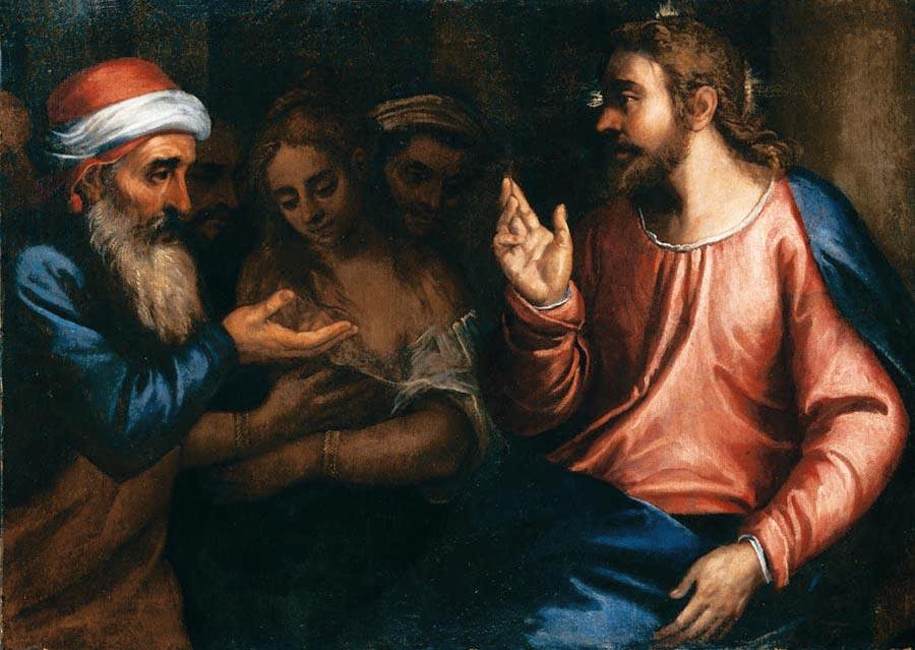
Andrea Vincentino, Christ and the Adulteress
Credit: Web Gallery of Art

May we all be a bit more tender with the manifest sinners in our lives. May our love for them draw them to Christ, Who is the only source of healing from the sores left by Lady Pleasure's reign. And may we each embrace His love and forgiveness, and welcome Him to heal the wounds of our own sins.

Propitius esto, parce nobis, Domine.
Propitius esto, exaudi nos, Domine.

Tuesday, August 23, 2011

On What Constitutes Good Liturgy

It's simple, really:


 "Good liturgy is when they're closer to Christ on the way out than they were when they walked in the door." -Msgr. Moroney (41:20)

Monday, March 14, 2011

On celebration versus populum and the location of the tabernacle

Skimming through these old periodicals never ceases to give me new insight into old problems. Why didn't I start doing this months ago!?
In his address to the Assisi congress of pastoral liturgy on September 22, 1956, our Holy Father [Pius XII] declared: "To separate the tabernacle and the altar is to separate two things which should remain united by their origin and their nature. The question of how the tabernacle could be placed on the altar without interfering with celebration facing the people admits of several different solutions. On these the experts will give their opinion."

The Holy Father's remarks were generally understood to mean that he took both the liturgical and pastoral legitimacy of the altar versus populum for granted, that he accepted as certain the possibility of reconciling a worthy tabernacle with such an altar, and was encouraging the specialists (liturgists, artists and architects) to work on the problem and to come up with suitable solutions. The problem has now, however, eight months later, officially been declared insoluble.

"Liturgical Briefs," in Worship, Vol. XXXI, No. 10 (Nov. 1957), 612.


Somehow, I suspect that this solution, which works well for our Eastern brethren, might not hold up so well in the Latin Church...

From the National Liturgical Week (conference) in 1950

In the Mass as celebrated in 1950, as in the EF now, the priest says the entire Our Father, and the servers respond with the last line only. There are no rubrics for the people. The custom now in most places I've been and heard of is for the people to sing the last line only. There is much talk of people singing the whole Pater Noster (as in many places they say the second set of Domine, non sum dignus with him, or try to), and I think this would be a laudable practice, both for its own sake and for the unity it would bring to the two forms of Mass. I encourage discussion in the comments (if any of you are still reading!).
Father Shawn Sheehan (Cambridge, Mass.): I would like to have Father Ellard tell us what are the official directives on the congregational recitation of the Pater noster.

Father Gerald Ellard (St. Mary's, Kansas): To the best of my knowledge that is an open question. By the analogy that the congregation recites at a Low Mass what it sings at High Mass or answers to the priest, the singing of the Our Father or its recitation by the congregation at a Dialogue Mass would seem to be ruled out. However, all things to the contrary not withstanding, there seems to be a custom in Rome that at High Mass the people sing the Our Father. And I saw a detailed description of two Dialogue Masses in Rome under papal control in which the recitation of the Our Father by the entire congregation was provided for. To the best of my knowledge, there is no prohibition of it, nor is there, beyond this example, any encouragement for it. This is as far as my knowledge goes. I know that there is quite a strong feeling that it would be a good prayer for the people to recite along with the celebrant. I know also that priests have the feeling that this would be a lay encroachment on a clerical privilege, and so I suppose the debate will go on until we have further direction.

Discussion after Gerald Ellard, S.J., "A Brief History of the Dialogue Mass,"
in For Pastors and People: National Liturgical Week 1950, Conception, Mo.: The Liturgical Conference, Inc., 1951, p95.


Note: In a 1963 issue of the journal Worship, a negative response is given to an inquiry about the above, but with the editor's expressed desire that such might change.

Saturday, March 12, 2011

How little things change in 80 years!


Somewhat more than three hundred years ago, the western world was set agog by the publication of a new astronomical theory. Men who had grown up in the belief that the earth was the center of the universe, were surprised at rumors that there could be a different axis about which all turned. People who felt confident of the stability and immobility of the earth became alarmed at the idea of their drifting through space. It was not easy to make them change their poitn of view. It was difficult to persuade them that the sun was the center, and the earth but one of many planets dependent upon it. The story of Galileo illustrates the hesitations, the controversies and the misunderstandings that had to be gone throught before the truth was accepted. It took time, it took explanation, and it took much conciliatory effort before old ways were adjusted to new ideas. But once the change was made the world was better for having a wider and truer horizon for its knowledge.

For the many millions of souls that have grown up in the faith under the influence of self-centered beleifs and practices, the implications of the liturgical movement come with a similar shock. Accustomed as they have been to have all devotions and spiritual exercises revolve about their own needs and advantages, they find it hard to accept the full significance of the liturgy’s “All for the greater glory of God!” Used to dominating and directing every detail to the end that their prayers and penances bring sensible consolation to them, they find it annoying to have to take part in exercises in which their personality does not seem to stand out sufficiently. It is not that they object to the Mass, but they prefer the benefit they seem to derive from the sermon—just as with priests and sisters there may be no question as to the expediency of saying the office, but they prefer the immediate benefit they seem to derive from the half-hour of meditation. Even the best disposed of us make the mistake of trying to crowd the liturgy into the scheme of private devotion. We become enamored of the art, the music, the ceremonies, the festivals of the liturgy, and proclaim ourselves ardent supporters of the liturgical movement because “we get so much out of it.” Between this subjective attitude and the objective nature of the liturgy there is a difference, a difference that may be noted by contrasting an ego-centric and a theo-centric piety. One of them looks to self, with its fears, its joys, its hopes. The other moves on the eternal axis of: “This is the Will of God, your sanctification.”

-J.L. Connolly, “The Liturgy and Personal Piety,”
in Orate Fratres, Vol. V, No. 10 (Sept. 1931), 453-454.

Wednesday, March 9, 2011

from "The Liturgy and Women"

The good Christian woman is as it were a natural sacrament in the world, an external sign of inner grace radiating goodness. She is a power for good in the world to which only the most debased of men will fail to respond, and whose active influence the world never needed more sorely than today. Her true mission she can fulfill, as of old, only by drinking deep at the fountain of the true Christian spirit, the life of the Church. She must become imbued with the spirit of Christ, as were the women of early Christianity. Above all, she must, under the moulding powers of the one true Sacrifice eternal of the Altar, become another Christ, burning with His own zeal to spread His kingdom in the hearts of men.
Virgil Michel, O.S.B., "The Liturgy and Women," in Orate Fratres, Vol. III, No. 9 (July 1929), 274-275.

No, I have not forgotten about this blog. Perhaps an inspirational quote will help to fill the page until my thesis is finished and I have time to return to blogging...

Thursday, May 7, 2009

On God Showing Off

'Cuz really, that's exactly what it is: unnecessary yet awesome.  I read the following this morning, in today's selection for the Proper of Saints from Dr. Pius Parsch's Year of Grace:

"The Breviary relates the following incident from [St. Stanislaus'] life.  King Boleslaus of Poland summoned the bishop before a solemn gathering of the nation's rulers and falsely accused him of illegally holding certain property that had, in fact, been purchased and paid for by him in the name of the Church.  But when he could not prove the transaction by documents and the witnesses were afraid to speak the truth, Stanislaus promised to bring before the court within three days the person from whom he had bought the ground, a certain Peter who had died three years previously.  His proposal was accepted with derisive laughter.

"Then the man of God spent three days in fasting and prayer; and after he had offered the Sacrifice of holy Mass on the third day, the day he was to re-appear in court, Stanislaus commanded Peter to rise from his grave.  Upon hearing the bishop's command, Peter immediately came to life, abandoned his tomb, and accompanied the bishop to the royal tribunal.  There to the consternation and utter amazement of the king and all his attendants, Peter gave testimony to the sale of the land in question and to the full and lawful payment made by the bishop.  Then he again fell asleep in the Lord."

Tuesday, May 5, 2009

On Vapid, Catchy, Popular Love Songs


I awoke in the middle of last night (thank you, hormones) and remained awake, despite my best efforts, for nearly an hour.  This in and of itself should be frustrating enough, but the kicker is the song lyrics that were running through my head the entire time:

Background: Taylor Swift's Romeo approaches, after having blown her off recently, with no obvious sign of an impending apology.  She's debating whether to blow up at him for being a jerk when
He knelt to the ground and pulled out a ring and said:
Marry me, Juliet, you'll never have to be alone.

I love you and that's all I really know.
I talked to your dad, go pick out a white dress.
It's a love story, baby, just say 'Yes!'"

Emphasis mine.  As this ran incessantly through my head I couldn't help but reflect upon the insight she gives to the general-societal portrayal of marriage as a remedy for loneliness (makes me almost miss the remedy for concupiscence).


I hear this song at work every single day (I exaggerate not - L can confirm the emails I send her daily when this song hits).  There are many such songs, that are on the daily playlist.  All my co-workers feel the same:  we've come to hate these songs...  and yet we can't help but sing along. Sirius/XM Radio, you are the bane of my existence!  (For which, I suppose, I should be grateful.  There are much worse things out there.)


I should adopt W's philosophy of complaining.  'Cuz it really is very funny at times...


And if you're not familiar with the song above:  1) I am most jealous, 2) You're really not missing much, 3) I'm sure your mind has jumped to similarly vapid-yet-catchy tunes.  Feel free to suggest some in the comments.


If anyone actually used my comments, this could be a really funny comment thread.  :)

Saturday, January 17, 2009

On Dieting

Even as a child, I didn't want to be thin. I have a specific memory of watching Boy Meets World with a friend in the early stages of puberty (our puberty, not the characters' - I think this was their first year of college) and thinking to myself, I wanna look like Topanga - i.e., curvy with a flair, rather than just stick thin like the rest of the girls.

Fast forward about a decade. I am happy with my body shape, and have never struggled with an eating disorder (unlike a good percentage of my peers). I haven't always had good nuitrition, but I've been trying to work on that in recent years, with some success. But I've never felt ashamed of my body (dissatisfied with parts, sure, but not stronger than that), even when I've had to shop in the Plus Sizes section.

Now that I'm working, I'm exposed to the outside world in a way I never was before, even in high school. Before the new year, my office had about two solid weeks of holiday parties and extra food brought in and culinary delights dearly enjoyed... That abruptly stopped after the new year. More than half of my co-workers, several of whom are thinner than I've been since childhood, have made recent comments about their dissatisfaction with their current weight. Our entire company is sponsoring a "Biggest Loser" contest, based on the tv show, in which the team of people who loses the greatest percent of total body weight wins a cash prize. My department had more people want to play than there was room for on one team. And I felt almost guilty for not piping up to join them.

Even still, it didn't really hit me how hung up people get on being thin until I overheard one girl at lunch mention looking through her photo album of this summer's vacation. "I wanted to be sick," she said with disgust. "I was so thin!" she longed regretfully.

Now segue back into my own life. A few months ago, I would have found this disgust completely incomprehensible. As I said before, I've never wanted to be thin, so it's hard for me to see the appeal. But this whole working out bit has opened up a can of worms....

When I went for my three-month check-in with my personal trainer a few weeks ago, we learned that I had not lost even half a pound. What I did lose was fat - 5% of my body fat, all replaced by muscle. For those who can picture it, that means half an inch off my hips and an inch and a half off my waist. This is a big deal - like, the jeans that fit perfectly in September I can now wiggle out of without unbuttoning. And it's a nice feeling, to be toned down and shrunk just a bit, without losing my general curviness.

And now the temptation hits. Now the fear of gaining fat, or of eventually losing the muscle mass I've developed. Now the desire to tone up for the summer so I'll look extra good in a bathing suit. It's like I've gotten a taste of that delightful Turkish Delight, and I just want more, and forever.

What happened to that peace about the fact that I weigh 170 lbs, and that's ok? Was it really such a fragile peace, that it could be shattered by mere muscle growth?

Last week I was reading a book called Jane Austen's Guide to Dating by Lauren Henderson (don't judge me, ok? I had a gift card, it was on the bargain bookshelf, and it looked enjoyable), and the following few sentences really stuck out at me:


My grandmother could never understand the modern fascination with incessant dieting: "In my day," she would say firmly, "you were fat or thin or middling and that was just the way you were. And there was always a man who preferred women who looked like you, so there was absolutely no reason in the world to be silly about dieting" (91-92).

What on earth happened to that? And I know I'm one of the lucky ones - neither my mom nor my grandmothers nor my aunt ever thinned themselves vicariously through me, and I've long been convinced of my own innate beauty. Today I was reminded again of the sad fact that an unfortunate majority of girls grow up extremely self-conscious about their weight, thanks principally to their mothers (aided, certainly, by celebrities and magazines and whatnot).

So what to do? My situation has become unfortunately like that of a platonic friendship between a man and a woman, when the point of innocence has been shattered and romantic tension has entered the picture on one side or the other: I must recognize the balancing act that's ahead of me, and charge ahead anyway. I will continue to try eating healthily, but will also allow myself to indulge from time to time (mmm, chocolate). And I'll keep working out, but won't allow myself to go crazy with it. And I will remind myself that I am beautiful, even with some fat on my bones - always have been, and always will be.

And I might stop fasting from junk food. Every time I do that, I think it's for God, but really, it's for my gut (in ever-futile hopes of its shrinkage). :)

Friday, December 26, 2008

On Christmas Gifts

I left home for Mass a little later than usual this morning, due to a changed Mass and confession schedule. As I turned that first corner, I was greeted by a beautiful golden orange sky, and was taken aback. I'm usually not one to be stunned by the colors the sun paints in the clouds each day, but the coloring of this particular view of the heavens was just breathtaking. As I drove on, I found myself desiring to drive east, just so that I could gaze longer upon this magnificent skyway. But alas! my road to work lies southwest, and as I merged onto the highway the sun behind me was so bright that the green road signs glinted orange in reflection.

O Radiant Dawn, splendor of eternal light, sun of justice: come, shine on those who dwell in darkness and the shadow of death.
This morning's sunrise truly gave me a glimpse of what a radiant dawn looks like: its light thoroughly illuminates everything and brings a natural sense of joy and goodness. What a gift, in this octave of Christmas, to receive a deeper understanding of those O Antiphons that prepare us for Christ's coming in Bethlehem, in the parousia, and in our hearts.

Merry Christmas, everyone.

Thursday, October 16, 2008

On Human Nature

Fr. Dr. Dan Patee, TOR, PhD (hereafter Fr. Dan) once said in class to be careful about the phrase "only human." He pointed out that humanity was created for union with God and would return to such a state. When saying someone is "only human," you're putting their fallen humanity at odds with the perfect humanity once held by Adam and Eve, eternally held by Jesus and Mary, and to be held by all the blessed in heaven. At the time, I thought he had a point, but not an incredibly important one.

This morning's homily was a long thirteen hours ago, and I no longer remember his point, but Msgr. repeatedly referred to human nature where he meant fallen human nature, and I began to see the importance of Fr. Dan's point.

The author of The Cloud of Unknowing differentiates between two kinds of humility: imperfect humility and perfect humility. Imperfect humility is what we're all used to - knowledge of our own wretchedness, especially through knowledge of our sins. But perfect humility is all the more important for true union with God, as it is a knowledge of God's glory as it shines through in us - not through any merit of our own, of course, but simply because we are human. He points out that were humility merely the knowledge of our own sinful weakness, how could our Blessed Mother and her divine Son be humble?

I've come to agree with Fr. Dan. Humanity was created for heaven, and that is where we will again find perfected human nature; thus to say one is "only human" in reference to an error or a failing is greatly mistaken, and an intellectual offense against our own hope of heaven.

Next time you're tempted to dismiss a transgression with the phrase, "It's ok, you're only human" - think about this idea. Think about heaven. And hope.

Thursday, September 11, 2008

On Screens and Boxes

It's amazing how sitting in one place in front of a screen for eight hours a day makes one so tired!

I've been working temporary jobs (mostly just when someone needs a fill-in receptionist or whatever for an afternoon or a few days), and the workload's been low as of late. But this week I've been working full-time, and on Tuesday I noticed this pattern that I'd fallen into:
  • 8am-5pm: at work, surfing the 'net and answering the phones (save half an hour's lunch break)
  • 5-5:20pm: driving home
  • 5:20-7pm: watching TV with my sister
  • 6:15-6:45pm: eating while watching TV
  • 7-10:30pm: sitting in my room, on the computer
  • 10:30pm: start getting ready for bed and for work tomorrow
I compare this experience with other working friends and find that they're in the same predicament. Why is it that we are so drawn to technology, to machines that engage our brains (and maybe our fingers) but little else? Why is it so difficult, in today's fast-food / instant-communication society, to be disconnected? Why must I fight the feeling that it's essential to have read through all the latest news articles and blog posts before I can tackle cleaning my room? Is something disastrous going to happen if, at any moment, I'm not fully aware of the far-reaching implications of the latest insult Sen. Obama has leveled at Gov. Palin?

Of course not. But being aware of the goings-on of the world, and even simply being in constant communication with one's friends and peers, give one a sense of intellectual power and unity of purpose. Even having watched the latest episode of American Idol gives one a strong sense of solidarity with the rest of the nation.


Maybe it's just because my generation is so comfortable on computers that we look to them for refuge even when we're seeking refuge from too much time spent on computers. Maybe it's also connected to the vast reaches of the internet. I'm reminded of one bullet-point from the fantastic Evil Overlord List:
Finally, to keep my subjects permanently locked in a mindless trance, I will provide each of them with free unlimited Internet access.
That does sound something like working as a receptionist, except that I have the interruptions of the occasional phone call or doorbell.

None of my jobs were ever fancy enough to give me
a headset, but this gives the general idea.
And as for the TV, I'm reminded of a scene from Stargate: Atlantis in which two men from earth (Sheppard and McKay), are discussing with two crew members who are not from earth (Ronon and Teyla) what their respective peoples do for entertainment. For sake of clarity, earthmen are blue and aliens are green.
Ronon Dex: So people just sit and watch this box for hours at a time?
Maj. John Sheppard: Yeah, people do.
Teyla Emmagon: Is it that engaging?
Sheppard: Depends what's on it. There are lots of programs on dozens of channels, every day, all day.
Dr. Rodney McKay: Most of which are fictional representations of ridiculously attractive people in absurd situations
Sheppard: There are educational programs, all sorts of documentaries. Not many people watch 'em but, uh, well, they're on.
Ronon: And that's what everybody on your planet does for entertainment? Watch a box?
Well... Kind of. Humbling, isn't it? Makes me want to stop in at the health club on the way home fromwork and go for a run on the machines. I know, that still has me inside an air-conditioned building using a machine, but it's progress. Baby steps.

Tuesday, September 9, 2008

On Balance

(I know this is somewhat after the initial splash, but I took my time to process this fully. Cut me a break - I'm new at this, ok?)

St. Thomas de Sales often said, in much prettier words, that you catch more flies with honey than with vinegar - "truth tempered with charity," or something like that.

This sounds great in concept, but in practice, where does one draw the line? Bishop Niederauer of San Francisco initially got some flak for inviting Nancy Pelosi to a conversation, rather than giving a diatribe about the obviousness of her error, after her notorious recent comments about abortion. While I usually agree with the juggernauts of the Catholic blogosphere, I found myself staunchly on Neiderauer's side: unpopular as his statement may have been, his responsibility is for the souls for his flock, including hers. Perhaps he didn't excoriate her because he knew that wouldn't draw her to Christ (and besides, over two dozen other bishops had made the issue abundantly clear already).

You can't compromise the truth! People have a very real right to know the truth. But you can't convert people with a sledgehammer, as my professors frequently reminded my classmates and me. The hardcore road may be very attractive to many of us, especially when beaurocracy and politics and red tape make life needlessly difficult. But that doesn't mean that it's necessarily the best way to do things.

So what's the balance? How do I avoid being an overbearing charismatic, a bitter traditionalist, a liturgical terrorist, on the one hand, but equally to avoid being lukewarm, a sellout, jaded and apathetic? How do I compromise neither Christ's Truth nor my Christian responsibility to usually not be a jerk to other people?


I don't have an answer here; just questions. I think this whole post can be summed up in the words of St. Josemaría Escrivá that I read between beginning this post and finishing it:
The charity of Jesus Christ will often lead you to make concessions. That is very noble. And the charity of Jesus Christ will often lead you to stand your ground. That too is very noble.
He has a wonderful way of stating things in an obvious, simple, and very challenging way. The question now is simply one of discerning when to concede and when to stand firm...
Related Posts Plugin for WordPress, Blogger...